# Overview
Systematic literature reviews (SLRs) are a structured, reproducible method for identifying and synthesizing existing research to answer a focused research question. This page will guide you through the concept and process step by step.
### What Is a Systematic Literature Review?
An SLR is a scholarly synthesis of evidence on a clearly defined topic, using explicit, pre-specified methods to identify, select, critically appraise, and summarise relevant studies. Unlike ad hoc reading of literature, every decision is documented so the review can be replicated.
- Minimizes selection bias through predefined inclusion/exclusion criteria
- Provides the highest level of secondary evidence for a research question
- Common in business research (e.g., management, HRM, strategy, marketing) theses
#### SLR vs. Traditional Literature Review
| Feature | Traditional Literature Review | Systematic Literature Review |
|---|
| Research question | Broad or flexible | Narrow and pre-specified |
| Search strategy | Informal, author-led | Documented, reproducible |
| Study selection | Subjective | Governed by explicit criteria |
| Quality appraisal | Often absent | Mandatory |
| Reporting | Variable | Follows standards (e.g., PRISMA) |
| Replicability | Low | High |
Read more
A well-defined research question is the foundation of a systematic literature review. Every subsequent decision (which databases to search, what terms to use, which studies to include) flows directly from it. A question that is too broad produces an unmanageable volume of results; one that is too narrow may yield almost nothing. Structured question frameworks give you a reliable method for making your question precise and searchable before you open a single database.
Review [Define Your Research Question & Select Framework](https://libguides.whitecliffe.de/books/research-skills/page/define-your-research-question-select-framework) for more information on this topic.
Read more
A protocol is a written plan that specifies, **in advance**, exactly how you intend to conduct your systematic literature review. It is not complete until all 11/12 sub-sections below have been worked through and recorded. Writing the protocol is not a bureaucratic hurdle; it is the mechanism that makes your review transparent, reproducible, and defensible to examiners, supervisors, and future readers.
Review [Writing a Protocol](https://libguides.whitecliffe.de/books/research-skills/page/writing-a-protocol) for more information on **why it matters** and **what it contains**.
Read more
This step translates the search strategy you documented in your [protocol](https://libguides.whitecliffe.de/books/research-skills/page/writing-a-protocol) into actual database queries, records the results systematically, and prepares a clean, deduplicated set of references for screening. Precision and documentation at this stage are critical: every decision you make must be recorded so that your search can be reported transparently in your final thesis.
Review [Conducting Your Search](https://libguides.whitecliffe.de/books/research-skills/page/conducting-your-search) for more information on this topic.
Before you search, use our [Search Quality Self-Assessment Checklist](https://libguides.whitecliffe.de/books/research-skills/page/self-assessment-checklist-for-your-slr-search) (adapted from [vom Brocke et al., 2015](https://aisel.aisnet.org/cais/vol37/iss1/9/)) to verify your search strategy meets the standards expected in a systematic review.
Read more
Screening is the process of applying your pre-specified inclusion and exclusion criteria to the deduplicated set of references produced earlier, in order to identify the studies that will form the basis of your review. It proceeds in two sequential phases: first by title and abstract, then by full text. Each phase reduces the total set further; only studies that pass both phases are included in your final review.
Review [Screening the Results](https://libguides.whitecliffe.de/books/research-skills/page/screening-the-results "Screening the Results") for more information on this topic.
Read more
Quality appraisal is the systematic assessment of the methodological rigor of each study included after screening. It answers the question: how much confidence can we place in the findings of this study? Appraisal does not judge whether a study is interesting or relevant (screening already established relevance); it judges whether the study was conducted in a way that makes its findings trustworthy.
Review [Appraise Study Quality](https://libguides.whitecliffe.de/books/research-skills/page/appraise-study-quality) for more information on this topic.
Read more
Data extraction is the process of systematically pulling the information you need from each included study and recording it in a standardised form. It bridges the gap between your screened, appraised set of studies and the synthesis you will conduct later. Consistent, thorough extraction is what makes synthesis possible: if you extract different information from different papers, you cannot meaningfully compare or combine them.
Review [Extract Data](https://libguides.whitecliffe.de/books/research-skills/page/extract-data) for more information on this topic.
Read more
Synthesis is where the work of the review becomes an argument. Having [identified](https://libguides.whitecliffe.de/books/research-skills/page/conducting-your-search), [screened](https://libguides.whitecliffe.de/books/research-skills/page/screening-the-results "Screening the Results"), [appraised](https://libguides.whitecliffe.de/books/research-skills/page/appraise-study-quality "Appraise Study Quality"), and [extracted data](https://libguides.whitecliffe.de/books/research-skills/page/extract-data "Extract Data") from your included studies, you now interpret what they collectively say in response to your research question. Reporting then translates that interpretation into a structured written account that meets the standards of academic transparency required for a thesis.
Review [Synthesize and Report](https://libguides.whitecliffe.de/books/research-skills/page/synthesize-and-report "Synthesize and Report") for more information on this topic.
Different disciplines and authors present SLR processes with slightly different stage names and orders. The seven-step structure presented here synthesises best practices from management research ([Tranfield et al., 2003](https://doi.org/10.1111/1467-8551.00375)), software engineering ([Kitchenham & Charters, 2007](https://legacyfileshare.elsevier.com/promis_misc/525444systematicreviewsguide.pdf)), and information systems ([vom Brocke et al., 2015](https://aisel.aisnet.org/cais/vol37/iss1/9/); [Bandara et al., 2015](https://doi.org/10.17705/1CAIS.03708)). The core sequence (question → protocol → search → screen → appraise → extract → synthesise) is common across all models; differences are primarily in emphasis rather than substance.
[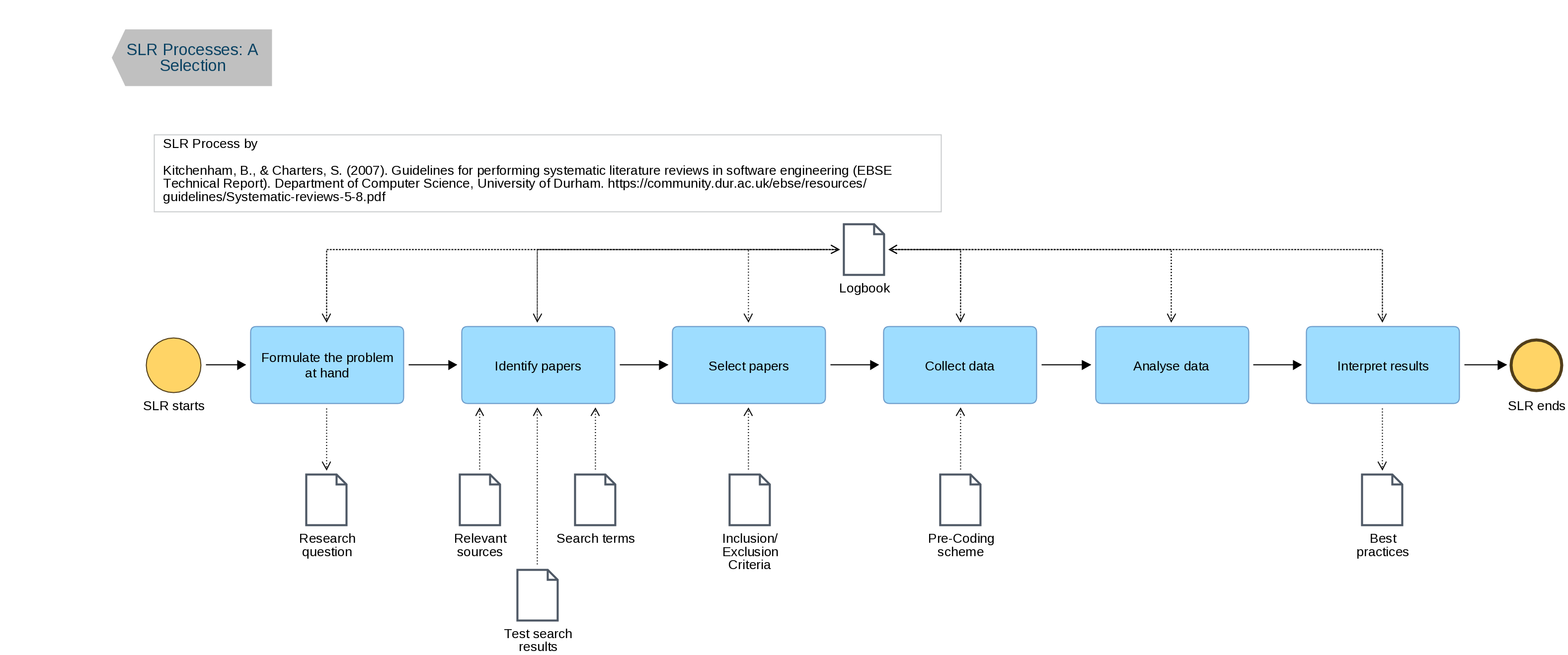](https://libguides.whitecliffe.de/uploads/images/gallery/2026-02/slr-process-by-kitchenham-and-charters-2007.png)
"SLR Process of Kitchenham and Charters 2007" by Hasan Koç is licensed under [CC BY-NC-SA 4.0](https://creativecommons.org/licenses/by-nc-sa/4.0/), based on [Kitchenham & Charters, 2007](https://legacyfileshare.elsevier.com/promis_misc/525444systematicreviewsguide.pdf).
[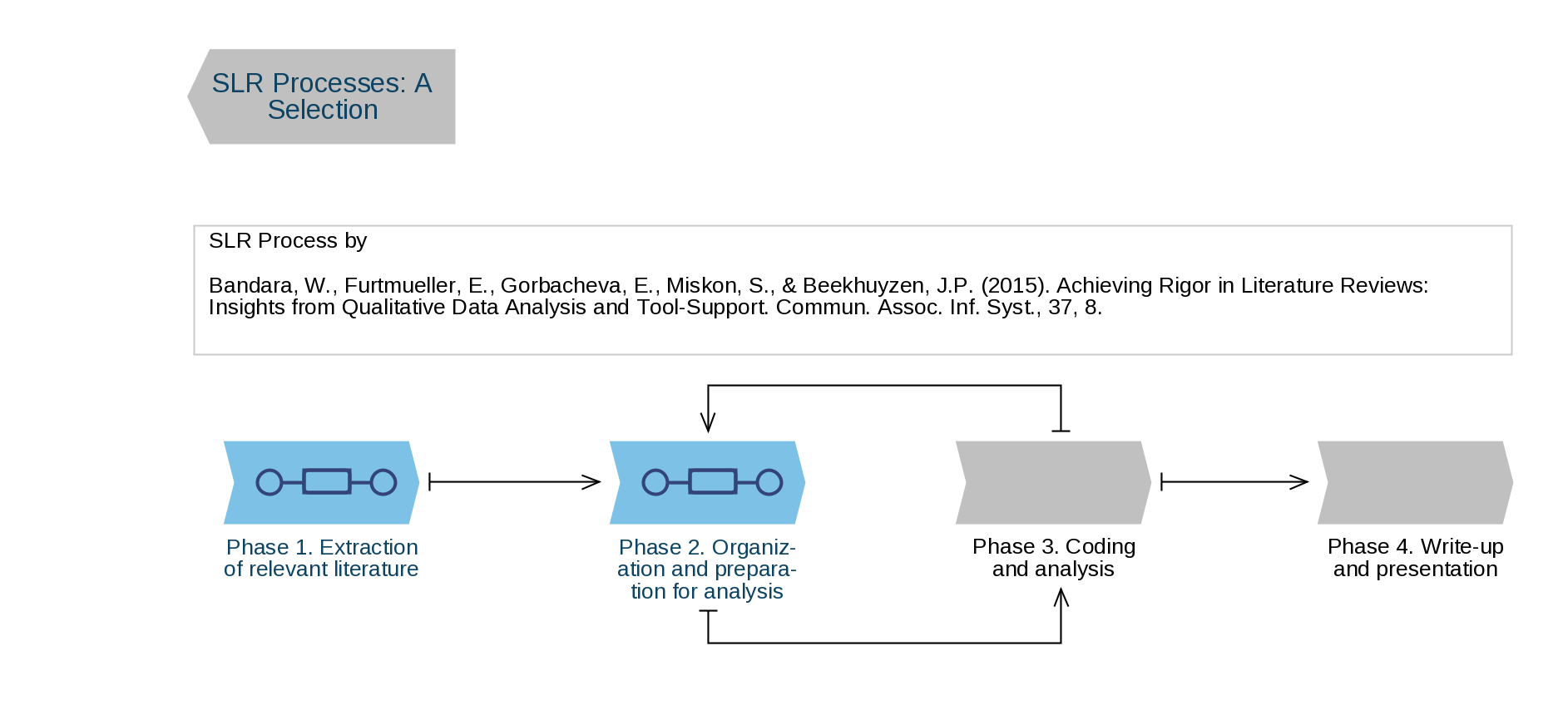](https://libguides.whitecliffe.de/uploads/images/gallery/2026-02/slr-process-by-bandara-et-al-2015.png)
"SLR Process of Bandara et al 2015" by Hasan Koç is licensed under [CC BY-NC-SA 4.0](https://creativecommons.org/licenses/by-nc-sa/4.0/), based on [Bandara et al., 2015](https://doi.org/10.17705/1CAIS.03708).